
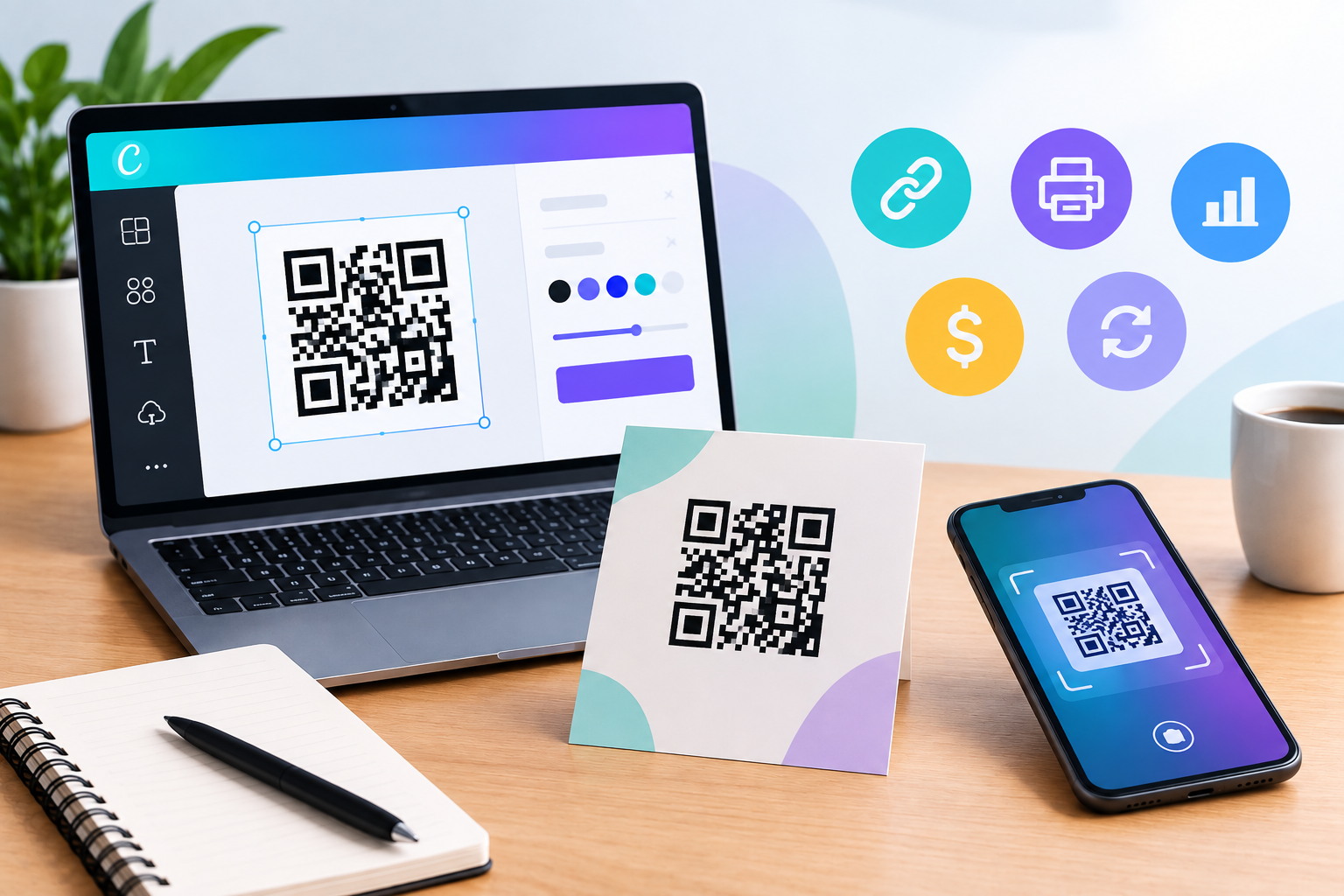
Create dynamic QR codes with real-time analytics. No credit card required.
Start for Free →The invoice is the least interesting part of this question.
A code made in the editor carries no line item, and a subscription decision made because of it would be a decision made for the wrong reason. The short answer to is canva qr code generator free is that the app is available on a free account and the code itself costs nothing to make. The longer answer is that generating the symbol was never where the money was.
Real canva qr code generator pricing is the cost of the printed asset over its life: the run you paid for, the run you pay for again when a destination changes, and the spend you cannot evaluate because nothing counted the scans. Those three numbers dwarf any subscription tier, and only the first of them appears in a budget.
It is worth separating what the plan buys from what the app does. A paid Canva plan buys design resources: stock assets, brand controls, background removal, storage, team features. The QR code app sits alongside those and is not the thing being sold, so upgrading does not add scan tracking, editable destinations or a code inventory, because those are not design features and the tool does not claim them.
The distinction is easy to lose because both things live in the same window. A person who has just generated a code inside a paid account reasonably assumes the code is part of what they are paying for, and only discovers otherwise when they go looking for a scan count that was never there.
That leaves a clean split in the budget, and writing it down prevents the most common misallocation, which is paying for a design tier in the hope of getting infrastructure.
Taken literally, the answer is no. There is no service between the scan and the destination, nothing in an account that the code depends on, and no renewal that can quietly switch it off. A card printed three years ago encodes the same address today that it encoded on the day it was exported.
The failure mode is the address, not the code. Everything that can go wrong is something that happens to the destination while the printed symbol goes on faithfully pointing at it.
That distinction matters commercially, because the two risks are managed in completely different places. The permanence of the symbol is free and needs no attention at all. The permanence of the address is a renewal, a hosting arrangement and a redirect policy, and those have owners, dates and small recurring costs attached. A business that budgets for the second one has already solved the version of this problem that catches everybody else.
The way to price this honestly is to ask how much of the print run is still in circulation when a destination changes. Five hundred cards in a drawer are a small loss. Twenty thousand catalogue inserts already with customers are not a reprint at all; they are an asset that quietly stops working while the accounting still shows it as delivered.
How much exposure a job carries depends on two figures nobody writes down at the time: how long a run stays in circulation, and how likely the destination is to move inside that window. A leaflet handed out over a fortnight carries almost none of it; a carton with a year of stock cover carries all of it.
It is worth doing the arithmetic on a real job rather than in the abstract. Take the unit cost of the last print run, multiply it by the proportion still undistributed, and add the value of the items already with customers that would simply stop working. For most small print runs the answer is trivially small, and the direct address is fine. For anything ordered by the thousand it is larger than every software cost in this article combined, which is the point at which the free tool and the cheap redirect stop being alternatives and start being two halves of one sensible arrangement.
It helps to write the whole thing down once, because the shape of the number surprises people who expected the answer to be a subscription price.
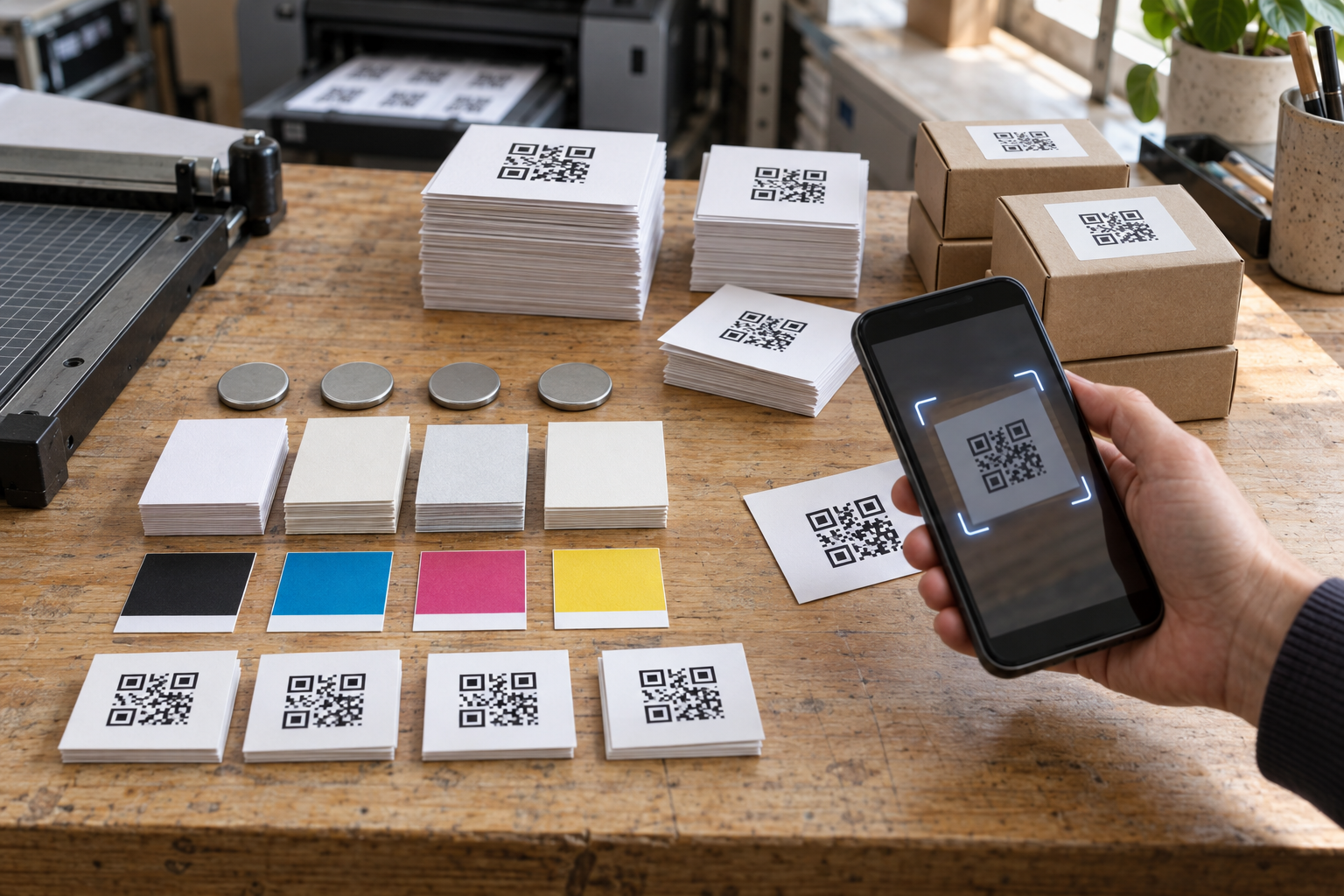
There is no scan counter in the app, so measurement has to be assembled at the destination. That is a limitation with a workaround rather than a wall, and the workaround is often good enough to answer the question a marketing budget is actually asking.
Decide the method before generating the code, not after printing it. Campaign parameters and a dedicated page both change the address that gets encoded, so choosing them later means a new symbol and a new print run, which puts the measurement decision inside the same reprint cost the rest of this piece is about.
Three approaches cover most cases, in increasing order of what they tell you.
The two payments people weigh at this point are not the same kind of payment.
One is a design subscription, billed monthly and visible to whoever approves software. The other is control of the destination: a domain renewal, and a redirect service if you want scans counted rather than arrivals inferred. Both are small sums. Only the second one changes what can happen after the print job leaves the building, which is what the lines above have been adding up to.
The asymmetry that follows is a budgeting problem rather than a technical one. Print is a single large figure, approved once, and nobody revisits it. A renewal and a redirect fee are small recurring figures, and small recurring figures are what gets reviewed, queried and cancelled when somebody tidies the list of monthly software. The large commitment survives the review because it has already been paid, and the cheap line that protects it does not.
Two situations show what that cancellation actually costs. A printed price list whose subscription tiers change mid-year needs its destination moved rather than its paper reprinted, and moving it is free only if somebody kept paying for the ability to move it. Business cards ordered in bulk and still in the drawer a year later are money spent and not yet used, so a destination that stops being correct writes off the remainder of the box rather than the handful already handed out.
Neither of those is an argument for a design tier.
Whatever method you choose, be clear about the gap between a scan and a session. Parameters and landing pages count people who arrived; they cannot count the person whose camera failed on a code printed too small, or the one who scanned in a car park with no signal and never loaded the page. Those are exactly the failures a print budget most needs to know about, and they are invisible at the destination.
Only a service sitting at the redirect sees the request itself, and that is the practical argument for putting one there.
There is also a comparison problem worth naming. One code across a whole campaign produces one number, and one number cannot tell you whether the poster or the flyer earned it, so the money keeps going to both. Separate addresses for separate printed items cost nothing extra to create and turn a single figure into a decision about next year's print budget. That is the cheapest improvement available in this whole area, and it has to be made before the artwork is finished.
Which brings the cost question back to where it started. The code is free, the design tool is priced for design, and the money that decides whether any of it worked is the small amount spent on controlling and counting the address behind the symbol.
There is one more figure that belongs in the calculation and never appears in a quotation: the cost of the conversation. When a destination has to change on printed material, somebody has to notice, somebody has to decide whether to reprint, somebody has to find the original file, and somebody has to explain to a manager why the flyers in reception are pointing at last year's offer. None of that is billed anywhere, and all of it is paid in hours by the people whose time is the most expensive item in the exercise.
Rank the five lines by size and the worry turns out to be attached to the smallest of them. The subscription question that starts most of these searches sits at the bottom of the list, and settling it either way leaves the four figures above it exactly as they were. A budget with room for one more item this year gets more back from owning the address and counting what arrives there than from any tier that redraws the same symbol.
Ready to create your first QR code? Start free on ConnectQR - no credit card required.
Create dynamic QR codes with real-time analytics. No credit card required.
Start for Free →